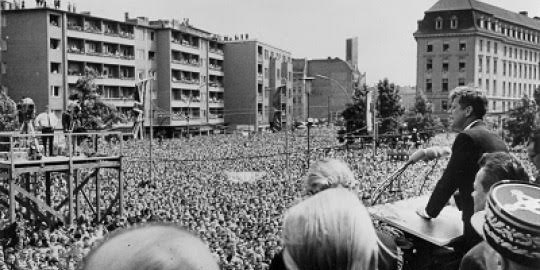
Through this article, we propose you to discover the history of John Fitzgerald Kennedy Platz. A travers cet article, nous vous proposons de découvrir l’histoire de la John Fitzgerald Kennedy Platz.
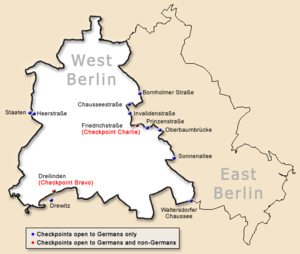
On June 26, 1963, Berlin was into a torn Germany. The city was separated by a wall between the West Germany and the Federal Republic of Germany (FRG) at east. At the core, John Fitzgerald Kennedy. Le 26 Juin 1963, Berlin est au cœur d’une Allemagne déchirée. La ville est séparée par un mur entre la RDA à l’Est et l’Allemagne de l’Ouest. Au centre, John Fitzgerald Kennedy.
At the 15th birthday of the Berlin blockade, the President of the United States decided to lend its support to the West Berliners who feared a possible invasion by the troops of the Soviet bloc. A l’occasion des 15 ans du blocus de Berlin, le président des États-Unis décida d’apporter son soutien aux berlinois de l’Ouest qui craignaient une possible invasion de la part des troupes du bloc soviétique.
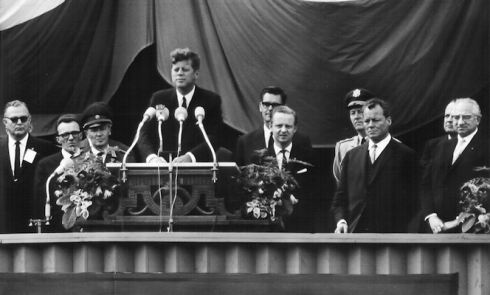
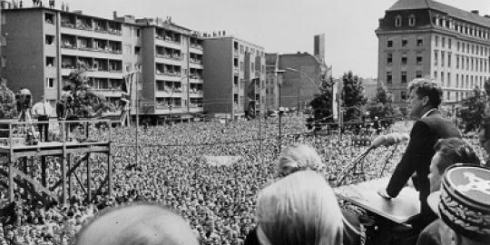
More than a million of Berliners joined him at the city hall of Schöneberg to listen to the speech that will go down in history. Plus d’un million de berlinois l’ont rejoint à l’hôtel de ville de Schöneberg pour entendre le discours qui entrera dans l’Histoire.
“I know of no town that still lives with the vitality and the force”
“Je ne connais aucune ville qui soit restée aussi vitale et forte”
“Freedom has many difficulties and democracy is not perfect, but we have never had to put a wall up to keep our people in, to prevent them from leaving us. I know of no town, no city, that has been besieged for 18 years that still lives with the vitality and the force, and the hope and the determination of the city of West Berlin. ”
« Notre liberté éprouve certes beaucoup de difficultés et notre démocratie n’est pas parfaite. Cependant nous n’avons jamais eu besoin, nous, d’ériger un mur pour empêcher notre peuple de s’enfuir. Je ne connais aucune ville qui ait connu dix-huit ans de régime d’occupation et qui soit restée aussi vitale et forte et qui vive avec l’espoir et la détermination qui est celle de Berlin-Ouest. »
« Ich bin ein Berliner »
His speech was ended by words, known by all, and pronounced by a man who felt that people are all free and equal in rights : “All free men, wherever they may live, are citizens of Berlin, and, therefore, as a free man, I take pride in the words “Ich bin ein Berliner!”
Ce discours s’est achevé par des mots, désormais connus de tous, et prononcés par un homme considérant que les hommes sont tous libres et égaux en droits : « Tous les hommes libres, où qu’ils vivent, sont citoyens de cette ville de Berlin-Ouest et pour cette raison, en ma qualité d’homme libre, je dis : Ich bin ein Berliner. »
This square was renamed John-F.-Kennedy-Platz on 25 November 1963, three days after Kennedy’s murder, and a large plaque dedicated to Kennedy was mounted on a column at the entrance to the city hall.
Ce square a été renommé John-Fitzgerarld-Kennedy Platz le 25 novembre 1963, 3 jours après le meurtre de Kennedy, et une grande plaque dédiée à Kennedy a été installée sur une colonne à l’entrée de l’hôtel de ville.
To discover the whole speech / Pour découvrir l’ensemble du discours : http://www.integrersciencespo.fr/index.php?article284/explication-ich-bin-ein-berliner-kennedy

