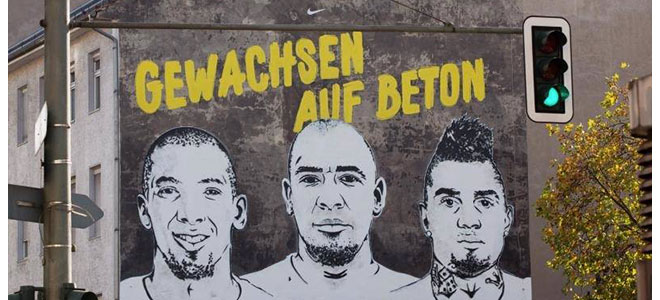
Berlin has seen the birth, growth and flourishing of many historical figures in diferent domains. Of all the historical figures in the city of Berlin, one today holds particular attention. Why ? Because in own societies which recline on her, he is the symbol in Germany, maybe despite him, of successful immigration and proud to be integrated and a of hope. Presentation of Jérôme Boateng, one of the best soccer defender on the world and a world champion in 2014 with the Nationalmannschaft and the presentation of the Boateng’s brothers. Berlin a vu naître, grandir, s’épanouir de nombreuses figures historiques, dans des domaines très variés. De toutes les figures historiques que compte la ville de Berlin, une aujourd’hui retient particulièrement l’attention. Pourquoi ? Car dans ces sociétés qui se replient chaque jour un peu plus sur elles-mêmes, il est le symbole, malgré lui, en Allemagne d’une immigration réussie et fière d’être intégrée ainsi qu’un message d’espoir. Portrait de Jérôme Boateng, l’un des meilleurs défenseurs de football au monde et champion du monde avec l’équipe d’Allemagne en 2014 et de la fratrie Boateng, indissociable.
It’s a story that has made a lot of noise in Germany, especially in Berlin where the Boateng’s brothers forming of Jérôme and Kévin-Prince, professional footballers and George, rapper, grew up. At the end of May 2016, Alexander Gauland, Vice-President of the Alternative Party for Germany (AFD) said about Jérôme Boateng that « people appreciate him as a footballer. But they do not want to have Boateng as their neighbor ». These words provoked a tremendous controversy over the Rhine and a poll revealed that 94% of Germans would like to have Jérôme Boateng for neighbor. The player, affected by the attack, declared that –« honestly it is sad that we still say that kind of things today. I’m happy to be a German, I’m proud of it, otherwise I would not be there on the national team. I’m well integrated and I have nothing more to say ». C’est une histoire qui a fait beaucoup de bruit en Allemagne, surtout à Berlin où a grandi la fratrie Boateng composée de Jérôme et Kévin-Prince, footballeurs professionnels et George, rappeur. Fin mai 2016, Alexander Gauland, vice-président du parti Alternative pour l’Allemagne (AfD) déclarait au sujet de Jérôme Boateng que “les gens l’apprécient en tant que footballeur. Mais ils ne veulent pas avoir Boateng comme voisin”. Ces propos ont provoqué un véritable tollé outre-Rhin et un sondage a même révélé que 94% des Allemands aimeraient avoir Jérôme Boateng pour voisin. Le joueur lui, affecté par la polémique, déclarait qu’ « Honnêtement c’est triste qu’on dise encore ce genre de choses aujourd’hui. Je suis heureux d’être Allemand, j’en suis fier sinon je ne serais pas là dans cette équipe. Je suis bien intégré et je n’ai rien à dire de plus ».
To understand Jérôme Boateng and why germans, and moreover berliners, love so much him, we need to look at his life. Jérôme Boateng comes from a working-class neighborhood in Berlin, born of a German mother and a Ghanaian father, in a complicated family context (each half-brother has a different father). While his two half-brothers grew up in the middle of disadvantaged neighborhoods of Wedding, he grew up mostly in a quieter neighborhood, Wilmersdorf. They met themselves, however, throughout their youths to play football on the “Panke”, a neighborhood plot located in the middle of Wedding. Pour comprendre Jérôme Boateng, et l’amour que lui porte les allemands et plus encore les berlinois, il faut se pencher sur sa vie. Jérôme Boateng est originaire d’un quartier populaire de Berlin, né d’une mère allemande et d’un père Ghanéen, dans un contexte familial compliqué (chaque demi-frère a un père différent). Alors que ses deux demi-frères ont grandi au milieu des logements populaires de Wedding, lui a majoritairement grandi dans un quartier plus calme, Wilmersdorf. Ils se retrouvaient cependant durant toute leur jeunesse pour jouer au football sur le « Panke », un terrain de quartier situé au milieu des logements populaires de Wedding.
Jérôme is the most shy and self-effacing of the free step-brothers. He is also the one who shows the most resilience and determination to reach the highest level, accepting the iron discipline of the german training centers, the suffering of training, the draconian rules of life, in order to become the essential player he is in the Bayern Munich’s team and the Nationalmannschaft. As symbols of success and integration, he is elected best player in the German 2016 Championship league and is close to become the first black captain of the German selection. Jérôme est le plus timide et effacé des trois demi-frères. Il est celui qui fait également le plus preuve de résilience et de détermination pour atteindre le plus haut niveau, acceptant la discipline de fer des centres de formation allemands, la souffrance des entraînements, les règles de vie draconiennes, afin de devenir le joueur essentiel qu’il est aujourd’hui au sein des collectifs de l’équipe allemande et du Bayern Munich. Comme symbole de réussite et d’intégration, il est élu meilleur joueur du championnat d’Allemagne 2016 et est en passe de devenir le premier capitaine noir de la sélection allemande. Une intégration mise en avant par le principal intéressé et salué par l’ensemble des allemands. Il est considéré comme un exemple sportif et un modèle d’intégration pour de nombreux jeunes de quartiers difficiles.
Life has forged his two half-brothers differently. His young half-brother Kévin-Prince, also a professional footballer, suffered mishaps in his youth, due to a more rebellious and less docile character, which closed him the doors of the selection of german football. Excluded from the under 21 German national football team for a nocturnal outing prohibited in nightclubs, Kévin-Prince chose in retaliation to represent the selection of Ghana, home country of his father, but where he never lived. He is less successful than Jérôme, leading an eventful career between renowned clubs as the AC Milan and more modest clubs like his current club, Las Palmas, in Spanish Premier League. The two half-brothers are the two only brothers to play one against the other during a World Cup match, in 2010. La vie a forgé ses deux demi-frères différemment. Son jeune demi-frère Kévin-Prince, également footballeur professionnel, a connu des mésaventures dans sa jeunesse, du fait d’un caractère plus rebelle et moins docile, qui lui ont fermé les portes de la sélection de football allemande. Exclu de l’équipe nationale allemande de foot des moins de 21 ans pour une sortie nocturne interdite, celui-ci choisi en représailles de représenter la sélection du Ghana, pays d’origine de son père, où il n’a jamais vécu. Il connaît moins de succès que son demi-frère, menant une carrière mouvementée entre clubs de renom comme le Milan AC et clubs plus modeste comme son club actuel, Las Palmas, en première division espagnole. Les deux demi-frères sont d’ailleurs les seuls joueurs à avoir joué l’un contre l’autre en Coupe du monde, lors de l’édition 2010.
His other half-brother, the oldest, Georges, is less known than the two others although he leads a known rapper career in Germany. During his youth, Georges known prison, because of a fight, but he was also the father of substitution of his two brothers, the hyphen of a very close family now. Son demi-frère aîné, Georges, est lui moins connu que ces deux autres demi-frères, bien que menant une carrière de rappeur en Allemagne. Durant sa jeunesse, Georges a connu la prison pour une bagarre mais a surtout joué le rôle de père de substitution pour ces deux autres frères, trait d’union d’une fratrie très soudée.
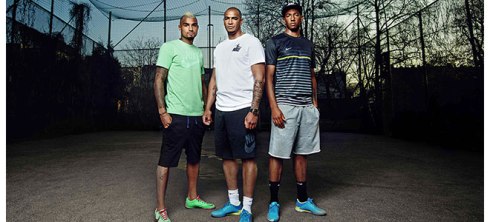 The german remake of the french movie « The three brothers »
Now, the three half-brothers beneficit a strong reputation in Germany and have become the symbol of a multicultural Germany. Their history fascinate the Germans to the point that a book “Peng-Peng Boateng” as well as a piece of theater from the book and with the same name, currently played in Berlin, are dedicated to them. Aujourd’hui, les trois demi-frères bénéficient d’une forte notoriété en Allemagne, sont devenus le symbole d’une Allemagne multiculturelle et leur histoire fascine les allemands au point qu’un livre « Peng-Peng Boateng » ainsi qu’une pièce de théâtre tirée du livre et du même nom leurs soient dédiés.

